1952
Let the Right One In1952 marks the arrival of residents in Blackeberg, a newly built suburb whose orderly modernity is set against the history it lacks. The year’s significance lies not in a founding spectacle but in the contrast between the imagined promise of a new beginning and the quieter reality of people settling into a place that already seemed complete.
A Planned Suburb Takes Shape
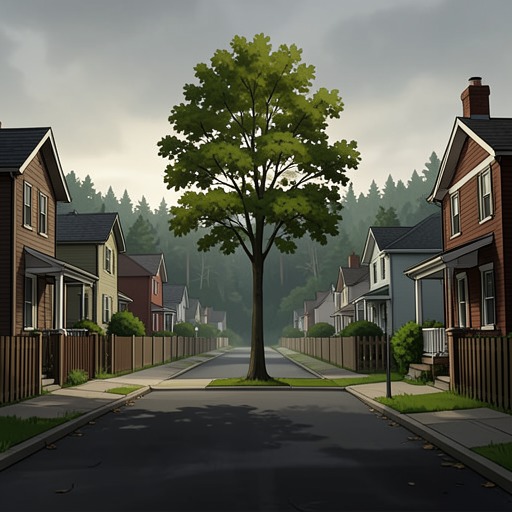
Blackeberg had been carefully planned rather than grown organically. Earth-colored concrete apartment buildings stood among green fields, and the development offered a town center, spacious playgrounds, nearby green spaces, and pedestrian-only paths. The built environment was designed to provide residents with a place to live; its measured apartments and surrounding public spaces made the suburb’s rational, modern character visible in everyday life.
The story evokes 1952 through an imagined procession across Traneberg Bridge: families arriving with sunshine and the future before them, mothers carrying or guiding children, and fathers bringing appliances and functional furniture rather than tools for building a settlement. That pioneer image gives the year the aura of entering an unknown land, but it is explicitly an imagined version of events, not a literal account of how the residents arrived.
The Reality of Arrival
In practice, people came by subway, car, or moving van, one household at a time. They unpacked into finished apartments, arranged their possessions on shelves and in cubbies, placed furniture on the cork floors, and bought new things to fill the remaining gaps. The difference between the imagined march and this piecemeal move-in undercuts the grandeur of a frontier beginning: Blackeberg was new, but its settlement was ordinary and domestic.
Once residents looked beyond their apartment doors, the land around them had already been claimed. Rather than discovering open territory, they adjusted to a finished arrangement of buildings and shared spaces. Their initial judgment that it was a good place to live coexisted with this sense that the ground had not been left open for them to shape.
Modernity Without a Past
When the story begins, Blackeberg has existed for thirty years, yet its children have no substantial local history to study. Accounts of an old mill, a tobacco king, and unusual buildings by the water belong to a past without a meaningful connection to the present suburb; the apartment blocks themselves stand where forest had been. The gap between the development’s recent construction and the thinness of its local past makes 1952 a starting point for a community that has little inherited history to orient it.
The absence is also marked by a striking civic detail: Blackeberg has nine thousand inhabitants and no church. The account connects that fact to the suburb’s modern rationality and its apparent freedom from historical ghosts and terror. In retrospect, this confidence becomes ironic. The residents’ lack of preparation is tied not simply to the suburb’s newness, but to a setting that seems to have escaped the past—and, with it, the expectation that something frightening might arrive.